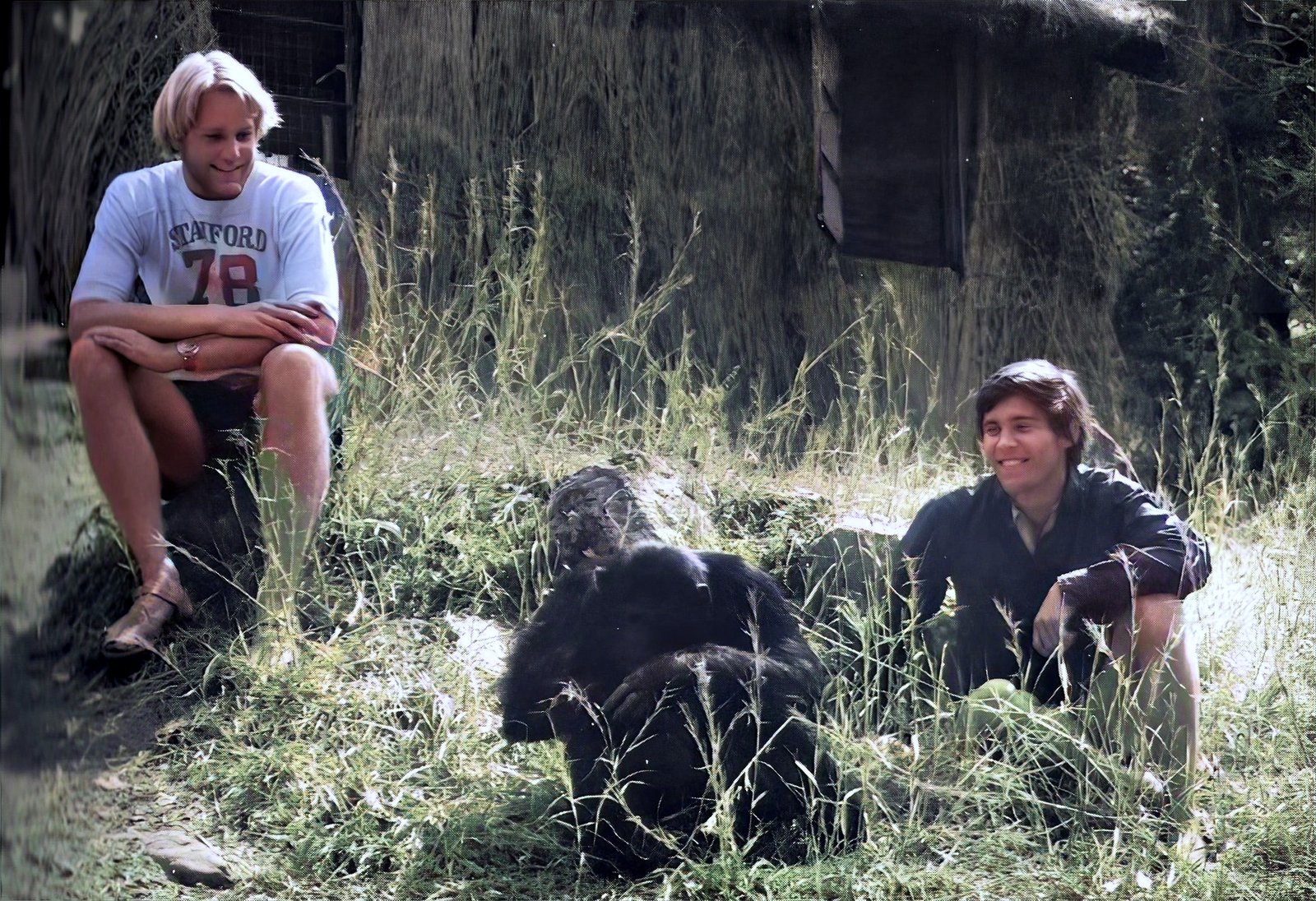
Curt Busse, Figan, and David Riss (photo by Jane Goodall, August, 1974)
“The fifty days with Figan gave us invaluable data about the social behaviour and social life of one of the most powerful top-ranking males Gombe has known, at a time when he was at the zenith of his career.” — Jane Goodall
Goodall, J. (1990). Through a window: My thirty years with the chimpanzees of Gombe. Houghton Mifflin. Page 58.
“The record must go to Riss & Busse (1977) who followed an adult male (Figan) at Gombe for 50 days in a row, clocking up 563 hours of observation.” — William C. McGrew
McGrew, W. C. (1992). Chimpanzee Material Culture: Implications for Human Evolution, Cambridge University Press. Page 31.
“After visiting Gombe fifty years later, I am awestruck by what David and I accomplished.” — Curt Busse
Synopsis
In 1974, Stanford graduates David Riss and Curt Busse carried out what became known as the “Figan Follow” — a marathon, 50-day continuous observation of Figan, the alpha male of the Kasakela chimpanzee community in Gombe National Park, Tanzania, site of Dr. Jane Goodall’s pioneering research. Over the course of 563 hours of direct observation, they recorded his every movement, activity, and social interaction.
Their work offered a detailed look into the daily life of a single wild chimpanzee, revealing how his travel patterns, feeding behavior, and social interactions changed with the availability of food and the presence of sexually receptive females.
Recent events at Gombe had shocked Jane and her research team when chimpanzees from Kasakela ventured into neighboring Kahama territory and violently attacked two males there — Godi and Dé. These brutal encounters would eventually be recognized as the opening salvos in what later would be referred to as the “Four-Year War.”
The Figan Follow emerged partly in response to these events. David and Curt reasoned that following the alpha male continuously might shed more light on territorial patrols. Though Figan and his group approached their boundaries several times during the fifty days, they never confronted chimps from other communities. Nevertheless, the project yielded some of the first ever photos of chimpanzees patrolling their territory (below, and detailed in Day 38).
The study also revealed key aspects of Figan’s social and predatory behavior. During the follow, he hunted red colobus monkeys on seven occasions and made at least three kills, showcasing his hunting skills. As alpha male, his actions reflected both his dominant position, through displays of power, competition, and mating behavior, and his cooperative ties with his older brother Faben, who supported his leadership.
Published in 1977 in Folia Primatologica, the Figan Follow remains a landmark in primatology: one of the most intensive, continuous studies ever conducted of a single wild chimpanzee, offering a rare, ground-level view into the life of a charismatic and powerful individual.
This web site consists almost entirely of the original reports, summaries, charts, and maps made by David, Curt, and their many collaborators during this concentrated study. This material is the intellectual property of the Gombe Stream Research Centre, which operates under the auspices of the Jane Goodall Institute.
Unless credited otherwise, photos from the Figan Follow are the work of Curt Busse. These images are freely available for download and use (see license agreement).
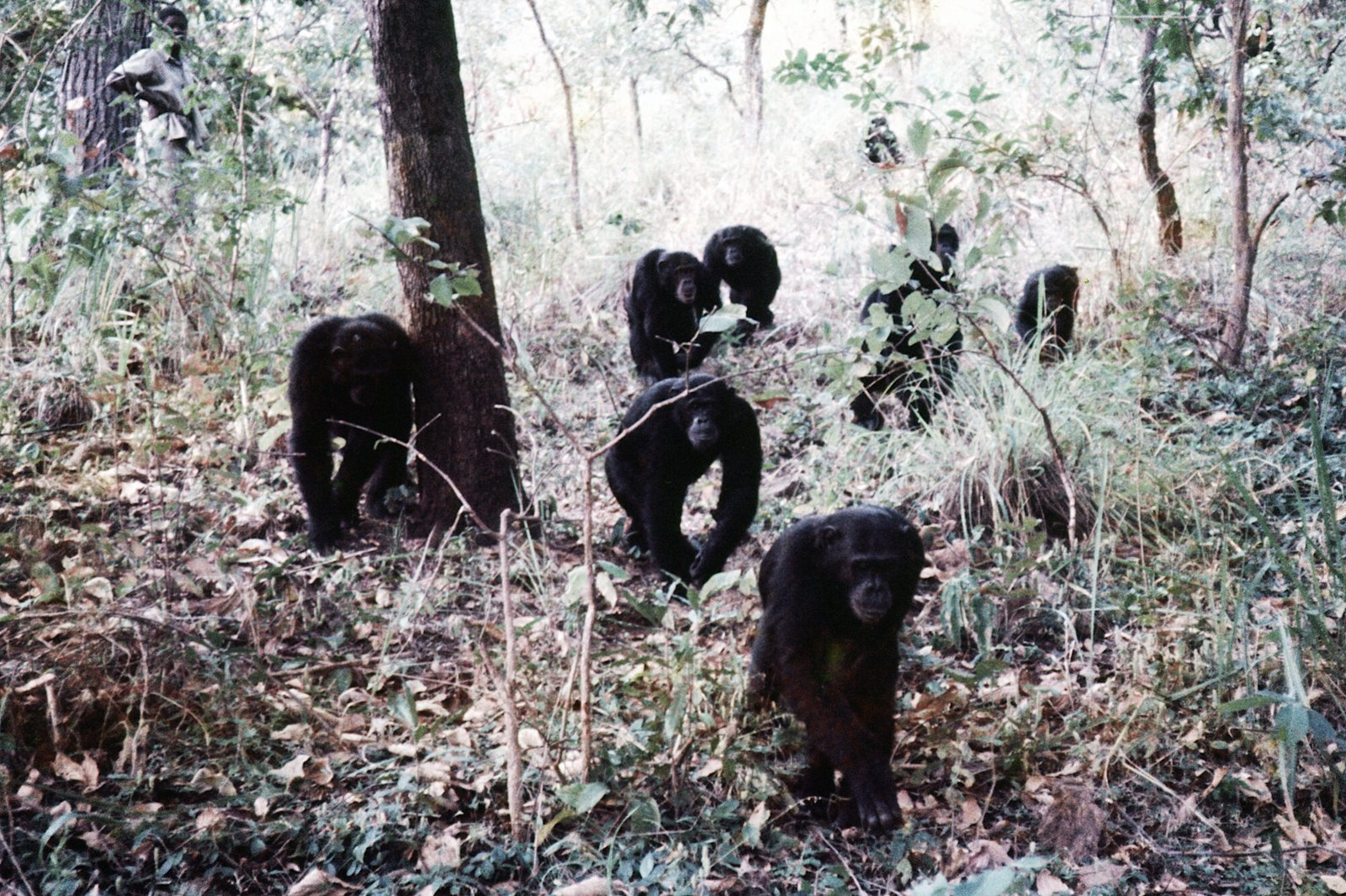
Adult male Sherry followed by Figan and other Kasakela males patrol deep into Kahama territory on Day 38 of the Figan Follow. 
The Figan Follow Team
The Figan Follow would not have been possible without Dr. Jane Goodall’s groundbreaking research on Gombe’s wild chimpanzees1 and her direct involvement in both approving and overseeing the project.
By the time of this study in 1974, Jane had amassed a wealth of information about the behavior, ecology, and social interactions of the chimpanzees, and she had created all of the infrastructure necessary for the success of this project.
David and Curt also owe their involvement to Professor David Hamburg — mentor, friend, and leader of Stanford’s Human Biology Program. Together with Jane, they created one of the greatest opportunities in the history of undergraduate education, in which students spent six months at Gombe gathering vital data on the social behavior of chimpanzees and baboons.
For the Figan Follow, David and Curt worked in four-day shifts, tracking the alpha male’s movements from dawn to dusk — typically twelve hours of continuous observation per day.
Safety protocols established in 1969 required that researchers never venture into the forest alone; each day, either Curt or David partnered with one of Jane’s Tanzanian field assistants or a fellow student researcher (detailed in the table below). These thirteen Tanzanian team members contributed crucial expertise to the project, meticulously documenting the chimps’ travel routes, foraging patterns, and social groupings throughout the study period.
|
Days |
Figan Follow Participants |
|---|---|
|
25 ½* |
Curt Busse, David Riss |
|
7 |
Cretus Chiwaga |
|
5 |
Petro Leo |
|
4 |
Hamisi Matama, Hilali Matama |
|
3 |
Rugema Bambanganya, Juma Mkukwe, Kassim Selemani, Yassini Selemani |
|
2 |
Molly Brecht, Esilom Mpongo, Emilie van Zinnicq Bergmann |
|
1 |
Donna Anderson, Adriano Bandora, Hamisi Mkono, Erin Moore, Jim Moore, Yahaya Ntabilio, Ann Pierce, Njuma Rukamata |
* David and Curt each followed for half of Day 6. They followed together on Day 50.
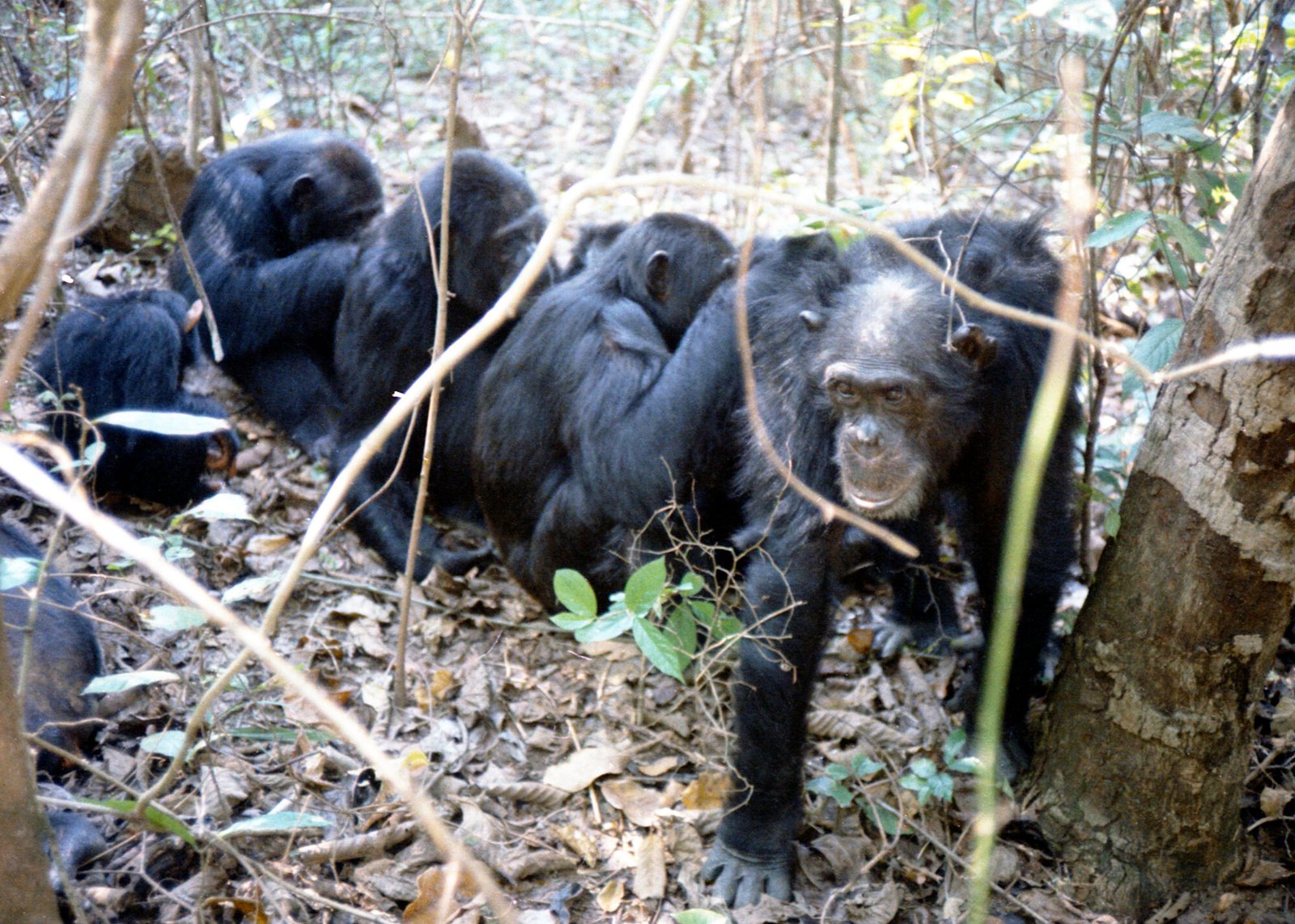
Evered grooms Faben who grooms Figan who grooms Hugo.
Chronology of Events Leading to the Figan Follow
- July 14, 1960. Jane Goodall and her mother Vanne arrive at Gombe to search for the elusive wild chimpanzees. By the end of the 1960’s, Jane has become a worldwide celebrity after making scores of exciting discoveries about the chimpanzees. Notably, they make and use simple tools, they occasionally hunt small mammals and eat meat, and they have distinct personalities reflected in their frequent expression of emotions.
- 1971. The Kasakela chimpanzee community begins to fracture following alpha male Mike’s fall from power. As Humphrey and Charlie (with Hugh’s backing) vie for dominance, a significant faction breaks away. This splinter group — comprised of seven males (Charlie, Hugh, Goliath, Godi, Dé, Willy Wally, and Sniff) along with several females — establishes itself to the south, becoming the distinct Kahama community by 1973.2
- February – July, 1973. David Riss, an undergraduate from Stanford, conducts research at Gombe on the Kasakela community’s adult male chimpanzees. During his fieldwork, he observes a pivotal power shift as Figan defeats Evered for alpha status after Humphrey’s demise. These observations later appear in a research paper in Folia Primatologica, co-authored by David and Jane.3
- January 7, 1974. While tracking eleven Kasakela chimps into Kahama territory, Tanzanian field assistants Hilali Matama and Yassini Selemani witness a shocking incident. The adult males — Figan, Faben, Evered, Humphrey, Jomeo, Sherry, and Hugo — ambush Godi, a Kahama male, inflicting severe injuries. This marks the first attack of the so-called “Four-Year War” (1974–1977), the violent conflict in which the Kasakela males hunted down members of the Kahama community, eventually wiping them out.
- January 11, 1974. Curt Busse, an undergraduate from Stanford, arrives at Gombe and begins an eight-month study of the Kasakela males.
- February 26, 1974. While tracking four Kasakela chimps through Mkenke Valley, Tanzanian field assistants Esilom Mpongo and Adriano Bandora witness another shocking event. Evered, Jomeo, Sherry, and Gigi corner the Kahama male Dé and launch into a savage assault. Coming just seven weeks after the attack on Godi, this second violent incident raises serious concerns among Jane and her team about the emerging pattern of aggression.
- April 6, 1974. At Jane’s invitation, David Riss returns to Gombe to assist in documenting the unexpected hostilities between the two chimpanzee communities.
- June 1974. David and Curt conceive a bold research plan: tracking the two dominant Kasakela males continuously for a month. Curt will follow Figan while David tracks Evered, enabling them to monitor the ongoing power struggle between these rivals and to collect data on territorial movements, particularly any confrontations with the Kahama community. Jane approves the project but establishes one firm condition: observations must cease immediately should either chimpanzee become upset.
- June 30, 1974. The study begins; Curt goes out with Figan while David goes with Evered. The first day yields immediate results when Figan successfully hunts and kills a red colobus monkey before leading his group to the northernmost boundary of their territory.
- July 3, 1974. After three days of continuous observation, Evered shows signs of uneasiness with the human observers. Given his reputation for eluding researchers and his tendency to vanish for extended periods, David and Curt decide to abandon their tracking of Evered and instead concentrate their combined efforts on following Figan.
- July 4, 1974. Jane approves of Curt and David’s revised plan to drop Evered and to extend the follow of Figan to fifty days. They christen their ambitious project as “The Behavior, Associations, and Ranging of Figan,” later to be known as “The Figan Follow.”
- August 18, 1974. As Figan prepares to build his nightly nest, David and Curt mark the end of the Figan Follow with toasts of konyagi, the local Tanzanian spirit, celebrating their unprecedented fifty days of continuous observation. Above all, they give thanks to Figan for being such a good sport and for sharing his adventures over the past fifty days.
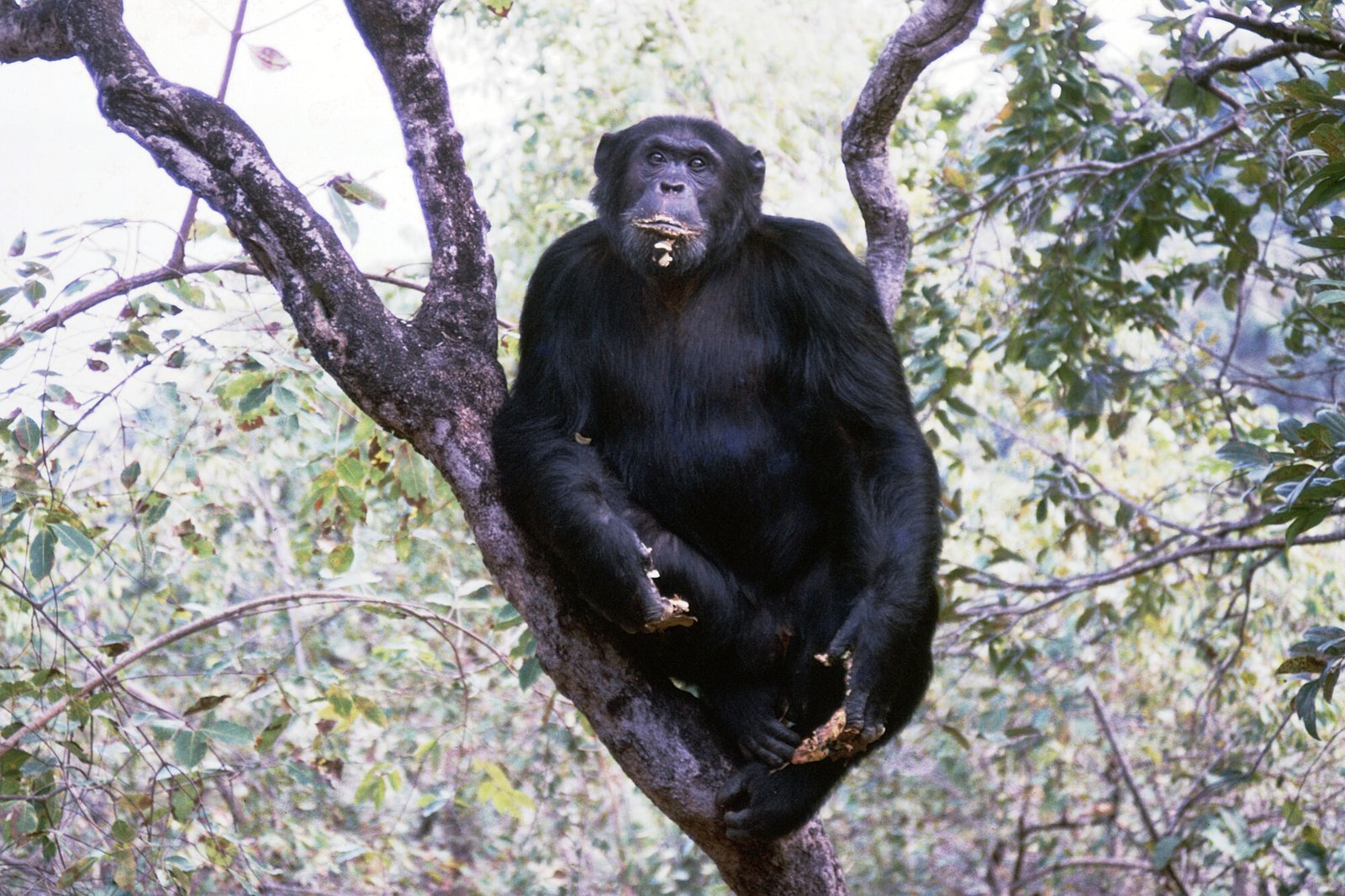
Figan after snacking on milk-pod seeds (local name: msongati).
- Goodall, J. (1971) In the Shadow of Man. Houghton Mifflin.
↩︎ - Feldblum, J. T., Manfredi, S., Gilby, I. C., & Pusey, A. E. (2018). The timing and causes of a unique chimpanzee community fission preceding Gombe’s “Four-Year War”. American Journal of Physical Anthropology, 166(3), 730–744.
↩︎ - Riss, D. C., & Goodall, J. (1977). The recent rise to the alpha-rank in a population of free-living chimpanzees. Folia Primatologica, 27(2), 134–151.
↩︎